
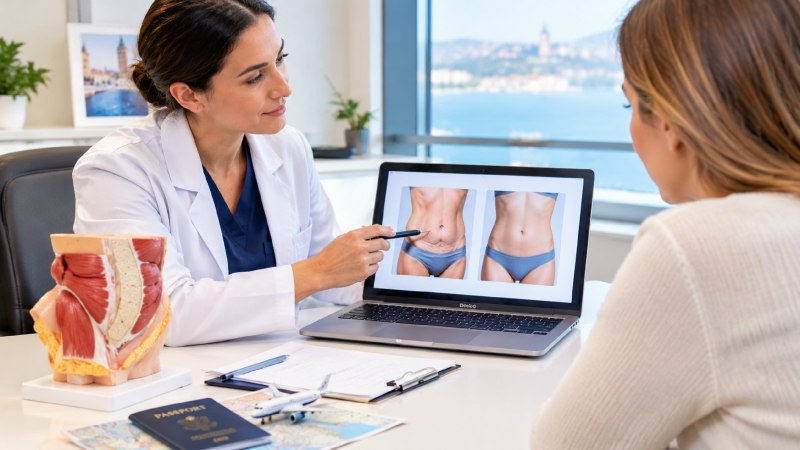
An abdominoplasty is a major abdominal operation. It is frequently discussed as though it were a cosmetic treatment, and that framing is where the planning goes wrong.
The surgery removes skin, tightens the abdominal wall and repositions the navel. Recovery involves drains, restricted movement, weeks of compression and a hard limit on lifting anything. None of that fits neatly into a week long trip, which is how many people initially schedule it.
This guide works backwards from the recovery. It covers which version of the operation applies to you, what each week afterwards realistically looks like, and how to build a travel plan that the healing can actually accommodate.
Which version of the operation applies to you
Four variants cover most cases, and they are not interchangeable.
A full abdominoplasty addresses skin above and below the navel, repairs separated abdominal muscles and repositions the belly button. It is the standard procedure after pregnancy or significant weight loss.
A mini abdominoplasty treats only the area below the navel. It suits a narrow group: good skin tone above the navel, a small amount of loose skin below it, and no significant muscle separation. Many people who want a mini are candidates for a full, and being told so is not an upsell.
An extended abdominoplasty continues around the flanks, and a fleur de lis version adds a vertical incision for patients with substantial horizontal excess, usually after major weight loss. The vertical scar is a real trade off and should be discussed explicitly.
Muscle repair deserves its own note. Diastasis recti, the separation of the rectus muscles that follows pregnancy, is the reason exercise alone does not flatten some abdomens. Repairing it is what produces the change in profile, and it is also what makes the recovery demanding. Ask whether it is included in the plan and in the quote.
People researching tummy tuck turkey options should establish which variant they are being quoted for before comparing anything else.
What each week actually looks like
Week one is the hard one. Expect drains, a compression garment worn continuously, and a bent forward posture because the abdominal skin has been tightened. Walking short distances begins almost immediately, since early mobilisation reduces thrombosis risk, but everything else is limited. Sleeping is in a semi upright position with the knees supported.
Week two usually brings drain removal and the first noticeable improvement in mobility. Most people still cannot stand fully upright without discomfort. Desk work becomes possible for some, though concentration is affected by fatigue more than by pain.
Weeks three and four bring a return to normal posture and light daily activity. Lifting remains prohibited, and that restriction is not negotiable for anyone with small children to carry.
Six weeks is the usual threshold for resuming exercise, with abdominal and core loading reintroduced last and gradually. Pushing this is the most common cause of a widened scar.
The final result is slower still. Swelling settles over months, numbness across the lower abdomen is common and often persists for a long period, and the scar continues maturing for a year or more. Judging the outcome at six weeks is judging it at its least flattering.
Building the trip around the healing
The schedule should be set by clinical milestones, not by annual leave.
Plan a stay long enough to cover drain removal and at least one wound check afterwards. Most surgeons ask abdominoplasty patients to remain in the country for a substantial part of the first fortnight. Confirm the number in writing for your specific operation rather than assuming a standard package length applies.
Fitness to fly is the constraint that matters most. Long haul travel soon after abdominal surgery raises the risk of venous thromboembolism, and seated immobility is precisely the wrong thing for a fresh abdominal repair. Ask for a written clearance before you travel, book a changeable ticket, take an aisle seat, walk during the flight and wear the compression stockings you are given.
Travel with someone if you possibly can. You will not be able to lift luggage, and in the first week even standing from a low chair is difficult.
Book accommodation close to the hospital with a lift and a bed you can get out of without using your abdominal muscles. These sound like small details until week one.
Build slack into the return date. An extended stay is the cost no package anticipates, and a fixed ticket creates pressure to fly before it is sensible.
The scar, and the belly button
A full abdominoplasty leaves a long horizontal scar across the lower abdomen. It is permanent. The honest framing is that you are trading loose skin for a scar, and anyone who finds that trade unacceptable should know it before surgery rather than after.
Scar placement is a design decision worth discussing. Bring the underwear or swimwear you actually wear to the consultation and ask the surgeon to mark where the line will sit relative to it. A scar placed low enough to conceal is not automatic, and it constrains how much skin can be removed, so it is a genuine conversation rather than a request.
The navel is repositioned in a full abdominoplasty, which leaves a second scar around it. Its appearance is one of the more variable aspects of the result and one of the more common reasons for minor revision.
Maturation takes time. Scars are raised and dark for months before flattening and fading, and people prone to hypertrophic or keloid scarring should raise that history in advance so it can be managed from the start.
Dog ears at the ends of the incision and small contour irregularities are common enough that a written revision policy is a fair thing to ask for.
Candidacy, risks and care once you are home
Stable weight matters more than a particular weight. Significant fluctuation after surgery alters the result, so the operation belongs after a weight loss journey rather than during one. Completed family planning matters for the same reason: a subsequent pregnancy can undo a muscle repair. Smoking is the most significant modifiable risk factor, because nicotine impairs blood supply to the skin flap and raises the rate of wound healing problems sharply. Most surgeons require several weeks of abstinence either side of surgery.
The recognised risks are bleeding, infection, seroma, wound separation, altered sensation, unfavourable scarring and venous thromboembolism. Seroma is common enough that you should know in advance who will drain one if it appears after you return home.
That is the question to settle before departure rather than after. Identify a local doctor who will remove any remaining sutures, check the wound and manage a seroma. Speak to them in advance rather than arriving with a healing incision and an operative report in another language. Bring the operative report, medication list and wound care instructions in English, and check your travel insurance, since many policies exclude elective surgery abroad and its complications entirely.
Anyone comparing quotes for a tummy tuck turkey trip should compare the variant, the inclusion of muscle repair, the required stay length and the revision policy. Those four decide the outcome far more than the headline figure does.
This article is for general information only and does not constitute medical advice. Suitability, technique, risks, recovery and results vary from person to person. Speak with a qualified surgeon about your own circumstances before making any decision.