
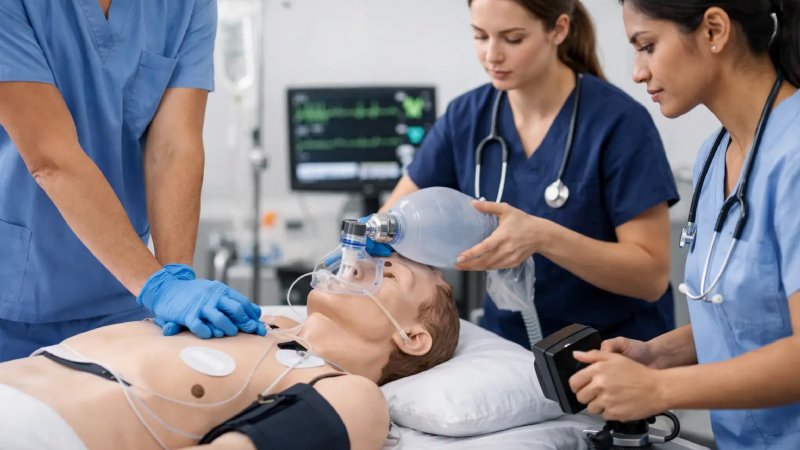
Acute care nursing in Australia demands split-second clinical decisions. When a patient rapidly deteriorates on a surgical ward or in a regional emergency department, the transition from routine care to high-intensity resuscitation happens in seconds. For healthcare professionals, completing an Advanced Life Support (ALS) course is the benchmark for bridging the gap between theoretical knowledge and decisive clinical action.
That is where structured als courses have become increasingly important for nurses working in emergency departments, surgical wards, ICU settings and regional hospitals. While Basic Life Support (BLS) focuses on immediate cardiopulmonary resuscitation (CPR) and automated external defibrillator (AED) usage, ALS training equips nurses with the advanced skills required to stabilize patients experiencing severe cardiac and respiratory crises.
Acute Care Environments Demand Fast Clinical Judgement
Nurses working in acute care environments are the primary defense line against clinical deterioration. Whether monitoring post-operative complications or managing an acute coronary syndrome (ACS) presentation, early recognition of physiological decline drastically alters patient outcomes.
An effective clinical response relies heavily on structured algorithmic systems. When a medical emergency team (MET) call or code blue is activated, acute care nurses must execute precise roles:
Clinical Confidence Changes Workplace Performance
The transition from a state of high-adrenaline panic to controlled clinical execution relies entirely on exposure. Early-career nurses often experience cognitive overload during their first few cardiac arrest scenarios. This freeze response rarely stems from a lack of textbook knowledge; rather, it is a byproduct of unpracticed situational stress.
Hands-on ALS training normalizes the high-pressure environment of an emergency room or intensive care unit. By internalizing the universal cardiac arrest algorithm, nurses stop second-guessing their actions. They know exactly what step follows the delivery of a third shock, how often to check for a pulse, and when to prepare the next dose of Adrenaline. This systemic predictability builds a level of clinical confidence that directly reduces workplace burnout and improves retention in high-stress specialties.
Common Situations Nurses Face in Acute Care
Acute care clinicians routinely confront high-acuity pathologies that require immediate escalation:
- Acute Respiratory Failure: Sudden drops in oxygen saturation secondary to pulmonary embolism, severe COPD exacerbations, or acute pulmonary edema.
- Post-Operative Hemorrhage: Hypovolemic shock requiring rapid fluid resuscitation and blood product protocols.
- Malignant Arrhythmias: Rapid atrial fibrillation with hemodynamic compromise, symptomatic bradycardia, or ventricular tachycardia.
- Sepsis and Septic Shock: Rapidly escalating systemic infections causing profound hypotension and organ hypoperfusion.
Regional and Metropolitan Hospitals Face Different Challenges
The operational realities for nurses vary significantly across Australia. In major metropolitan tertiary hospitals across Sydney, Melbourne, or Brisbane, acute care nurses operate alongside 24/7 dedicated medical emergency teams, ICU registrars, and intensive care consultants who can arrive at a bedside within minutes.
In regional, rural, or remote facilities, the clinical landscape looks vastly different. A regional nurse on a night shift may be the most qualified clinician on-site when a patient enters cardiac arrest.
In these under-resourced environments, advanced ALS skills are not a luxury—they are a critical necessity. Regional nurses must confidently lead a resuscitation attempt, manage a difficult airway, and direct junior staff until a medical retrieval team or senior clinician arrives.
Why Simulation Training Makes a Difference
High-fidelity simulation training is the core pillar of modern ALS education. It replicates the auditory and visual chaos of a live resuscitation bay without risking patient safety.
Simulation forces nurses to practice critical non-technical skills:
- Dynamic Leadership: Managing the room, assigning compressor roles, and appointing a dedicated timekeeper.
- Situational Awareness: Monitoring the quality of chest compressions (depth, rate, and full recoil) while simultaneously preparing emergency drugs.
- Closed-Loop Communication: Ensuring that when an order is given (e.g., “Give 1 milligram of Adrenaline”), it is verbally repeated, executed, and confirmed back to the team leader.
Experiencing these communication dynamics in a controlled environment ensures they happen naturally when a real life is on the line.
Professional Development and National Standards
Ongoing clinical education is transforming across Australian healthcare networks. The Australian Resuscitation Council (ARC) regularly updates its guidelines to reflect global evidence-based resuscitation science. For acute care nurses, maintaining an active ALS certification is no longer just about meeting annual Continuing Professional Development (CPD) hours or hospital compliance. It ensures your clinical practice aligns with current, verified survival strategies.
Signs a Nurse May Benefit From Additional ALS Training
It is entirely normal to feel a gap in your clinical preparation, especially when transitioning to higher-acuity environments. You may benefit from an ALS course or refresher if you experience:
- Hesitation or anxiety when a patient’s vital signs break tracking parameters.
- Difficulty identifying basic lethal rhythms on a cardiac monitor.
- A feeling of detachment or confusion during rapid response (MET) calls.
- Extended time away from acute clinical settings or returning from a career break
FAQs
What does an ALS course involve for nurses?
An accredited ALS course covers advanced airway management, rhythm interpretation, manual defibrillation, venous access, emergency drug protocols, and structured team-based simulation scenarios based on current ARC guidelines.
Is ALS training only useful for ICU and emergency nurses?
No. Nurses working in general surgical wards, coronary care units, recovery rooms (PACU), aged care high-dependency units, and rural facilities frequently encounter deteriorating patients and benefit immensely from ALS certification.
How often should nurses refresh their ALS skills?
While certifications are generally valid for one to two years depending on hospital policy, the ARC recommends regular skills refreshers to combat the natural decay of high-acuity, low-frequency clinical skills.
What is the difference between ALS Level 1 and ALS Level 2?
ALS Level 1 (Immediate Life Support) focuses on initial recognition, airway management, and safe defibrillation before the arrival of the resuscitation team. ALS Level 2 (Advanced Life Support) covers advanced team leadership, complex pharmacology, and identifying reversible causes of cardiac arrest (the 4Hs and 4Ts).
Take the Next Step in Your Clinical Career
Mastering advanced resuscitation protocols is the most effective way to eliminate bedside anxiety and deliver elite patient care when every second counts. Whether you are looking to transition into critical care, step into a senior nursing role, or secure your confidence in a rural facility, comprehensive training is essential.